

Advertisement
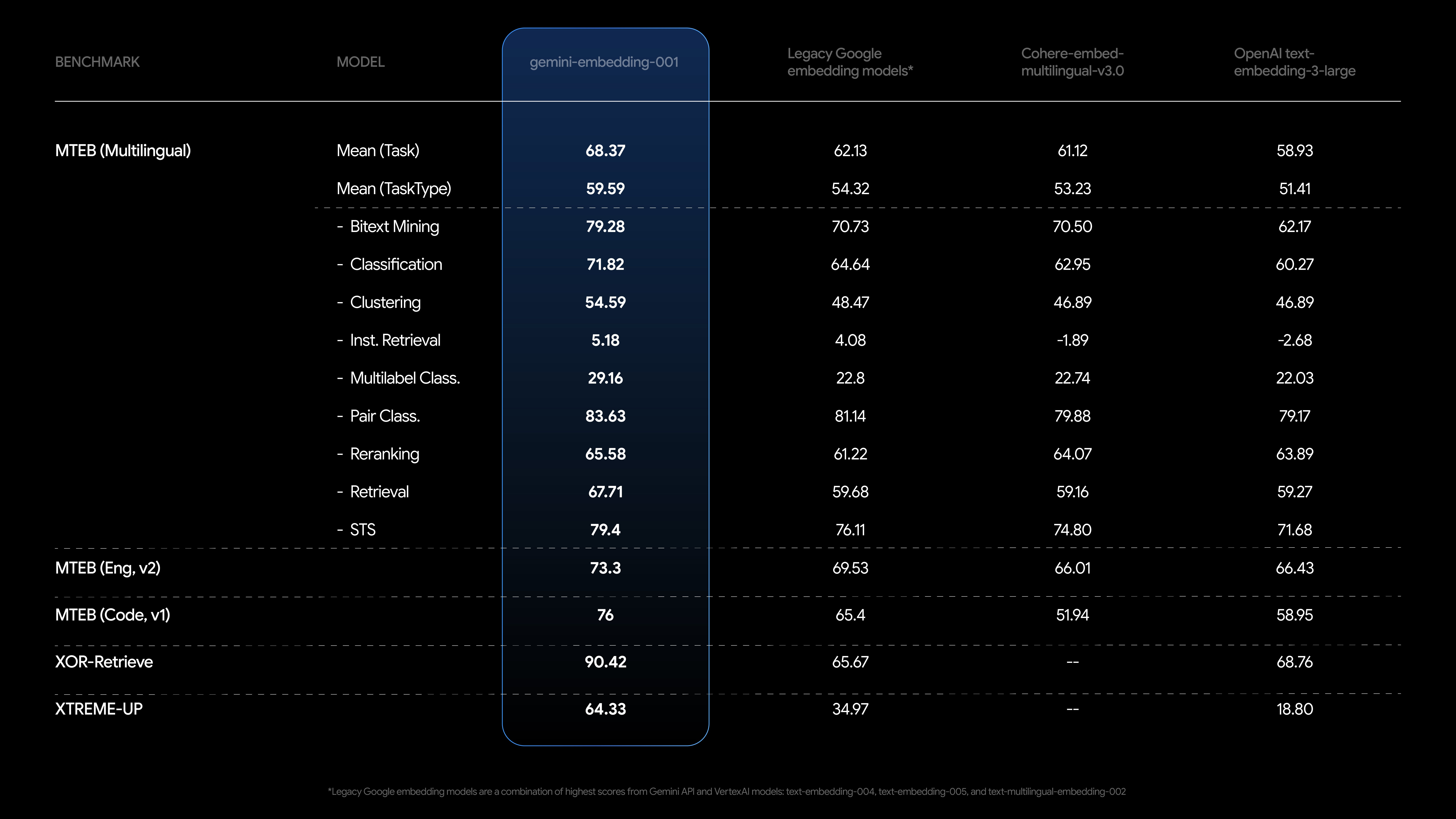
Google has officially announced the general availability of its new, high-performance Gemini Embedding model, which currently holds the top spot on the esteemed Massive Text Embedding Benchmark (MTEB). The model (gemini-embedding-001) is now an integral component of the Gemini API and Vertex AI, empowering developers to create applications such as semantic search and retrieval-augmented generation (RAG).
Although securing the number-one position marks a strong introduction, the field of embedding models is intensely competitive. Google's proprietary model faces direct competition from powerful open-source alternatives. This presents enterprises with a strategic decision: to adopt the top-ranked proprietary model or opt for a nearly equivalent open-source alternative that offers greater control.
What’s under the hood of Google’s Gemini embedding model
At their essence, embeddings transform text (or other data types) into numerical lists that encapsulate the primary features of the input. Data with similar semantic meanings have embedding values that are closer together in this numerical space. This enables the development of advanced applications that surpass basic keyword matching, such as intelligent retrieval-augmented generation (RAG) systems that supply relevant information to LLMs.
Embeddings are also applicable to other modalities, including images, video, and audio. For example, an e-commerce company might employ a multimodal embedding model to create a unified numerical representation for a product, integrating both textual descriptions and images.
AI Scaling Hits Its Limits
Power caps, increasing token costs, and inference delays are reshaping enterprise AI. Join our exclusive salon to learn how leading teams are:
Leveraging energy as a strategic advantage
Designing efficient inference for real throughput improvements
Achieving competitive ROI with sustainable AI systems
Secure your spot to stay ahead: https://bit.ly/4mwGngO
For enterprises, embedding models can drive more accurate internal search engines, advanced document clustering, classification tasks, sentiment analysis, and anomaly detection. Embeddings are also becoming crucial in agentic applications, where AI agents need to retrieve and match various types of documents and prompts.
A significant feature of Gemini Embedding is its inherent flexibility. It is trained using a method called Matryoshka Representation Learning (MRL), allowing developers to generate a highly detailed 3072-dimension embedding, which can be truncated to smaller sizes like 1536 or 768 while retaining its most relevant features. This flexibility enables enterprises to balance model accuracy, performance, and storage costs, essential for efficiently scaling applications.
Google promotes Gemini Embedding as a unified model designed to function effectively “out-of-the-box” across various domains such as finance, legal, and engineering, without requiring fine-tuning. This simplifies development for teams seeking a general-purpose solution. Supporting over 100 languages and competitively priced at $0.15 per million input tokens, it is crafted for widespread accessibility.
A competitive landscape of proprietary and open-source challengers
Source: Google Blog
The MTEB leaderboard illustrates that while Gemini leads, the margin is narrow. It contends with established models from OpenAI, whose embedding models are widely utilized, and specialized challengers like Mistral, which provides a model specifically for code retrieval. The rise of these specialized models indicates that for certain tasks, a targeted tool may outperform a generalist one.
Another significant player, Cohere, directly targets enterprises with its Embed 4 model. While other models compete on general benchmarks, Cohere highlights its model’s capability to manage the “noisy real-world data” often present in enterprise documents, including spelling mistakes, formatting issues, and even scanned handwriting. It also offers deployment on virtual private clouds or on-premises, providing a level of data security that appeals directly to regulated industries like finance and healthcare.
The most direct challenge to proprietary dominance comes from the open-source community. Alibaba’s Qwen3-Embedding model ranks just behind Gemini on MTEB and is available under a permissive Apache 2.0 license (suitable for commercial purposes). For enterprises focused on software development, Qodo’s Qodo-Embed-1-1.5B presents another compelling open-source alternative, specifically designed for code and claiming to outperform larger models on domain-specific benchmarks.
For companies already building on Google Cloud and the Gemini family of models, adopting the native embedding model can offer several benefits, including seamless integration, a simplified MLOps pipeline, and the assurance of utilizing a top-ranked general-purpose model.
However, Gemini is a closed, API-only model. Enterprises prioritizing data sovereignty, cost control, or the ability to run models on their own infrastructure now have a credible, top-tier open-source option in Qwen3-Embedding or can utilize one of the task-specific embedding models.
Advertisement
Hot News
Advertisement


